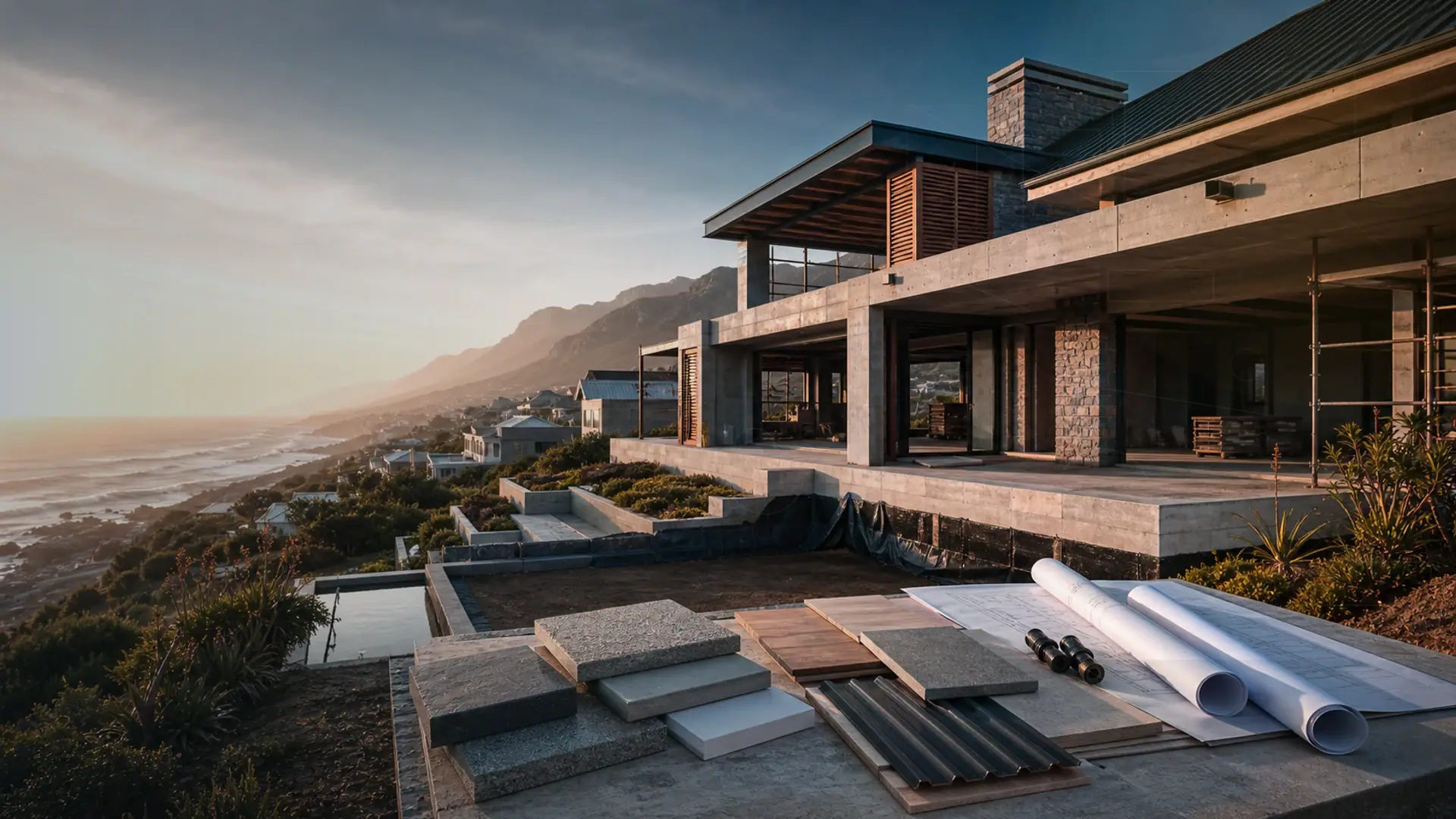
Cape Town Building Cost Guide
Heritage-sensitive renovations, coastal conditions, premium finishes, and strong contractor demand
Quick answer
Cape Town building prices – heritage consent, tight erven, slopes and salt air, plus the contractor demand that books trades out early.
11 min read
On this page
Curious how much it will really cost to create your new home in south africa? At buildingpricessouthafrica.co.za we cut through the noise so you can see clear cost ranges and make confident choices.

A small economic house can start from R9,500 per square metre in 2026, while higher-end homes may exceed R30,000 per square metre.
We guide you through the market dynamics that affect total costs. Materials, labour, finishes and site access all change the final estimate.
Our aim is to help you estimate the cost to build a house in the Western Cape with practical data and clear steps. You’ll learn what to confirm in writing and how to request up to three quotes from independent contractors.
This introduction sets the pricing-first tone you can expect across the article. Read on to understand scope, likely building costs and realistic figures for cape town projects.
Understanding Building Prices Cape Town and Market Realities
In 2026 the average cost per square metre in the Western Cape sits at about R13,150, a useful baseline that fits within broader building costs in the Western Cape.
The gap between a small economic house that starts near R9,500 per square metre and premium projects is wide. Location and land value influence the final cost build more than most homeowners expect.
Key factors that affect construction costs include:
- Scope of work and finishes
- Site conditions, access and labour rates
- Materials, contractor assessment and regional demand
When you request quotes, confirm what is included and set contingencies for unexpected expenses. Our analysis shows that careful planning reduces cost surprises for any new home or renovation in south africa.
Use the per square metre figure as a planning tool, not a final quote. Compare at least three contractors and check that rates cover both materials and workmanship.

Core Components Influencing Construction Costs
What you pick for materials and how complex the design is will shape most of your cost per square metre. Start by sizing the project: a common three-bedroom home is about 120 to 150 square metres. That range is the main driver of your total construction cost and helps set a clear budget.
Material quality matters. Bricks range from R1,600 to R6,000 per 1,000 tiles and roof tiles from R1,300 to R4,000 per 1,000. Higher-grade materials raise both material costs and labour time.
Design complexity also increases costs. Multi-storey plans, complex rooflines and bespoke finishes add to rates and the average cost per square metre.
Material Quality and Design Complexity
- Choose finishes to match your budget and long-term maintenance expectations.
- Use supplier price lists to estimate material costs for your plan.
The Impact of Building Size
Larger homes cost more overall, but per square costs can fall slightly with scale if design stays simple. Confirm what is included in quotes and allow a contingency in your budget.

| Item | Typical range | Impact on budget |
|---|---|---|
| Bricks (per 1,000) | R1,600 – R6,000 | Material costs, finish quality |
| Roof tiles (per 1,000) | R1,300 – R4,000 | Durability, labour time |
| Three-bedroom size | 120 – 150 mètre² | Primary cost driver |
Navigating Cape Town Specific Site Challenges
Local site conditions often add unexpected expenses to your per square estimate. You should factor in coastal exposure, heritage rules and tight access early when you set a budget.

Coastal Environment and Salt-Air Corrosion
Salt-laden air speeds corrosion and shortens the life of metal fixings and cladding. Use high-grade materials and extra waterproofing for wind-driven rain.
Expect higher maintenance costs and slightly bigger initial material expenses for coastal projects in the Western Cape. This pairs naturally with cost to build in on the Garden Route.
Heritage Consent and Older Stock
Many older properties require heritage consent, especially Victorian semis in the City Bowl. Consent adds time and administrative costs to your project.
Allow for consultant fees, specialist craftsmen and possible design changes to meet conservation rules.
Site Access and Parking Constraints
Tiny erven, no on-site parking and narrow streets raise logistics costs. Crane hire, off-site storage and slope scaffolding all affect the cost per square metre.
Check soil, slope and site size early — poor ground or steep terrain can add structural and excavation expenses.
| Site challenge | Typical impact on budget | What to confirm in quotes |
|---|---|---|
| Salt-air exposure | Higher material and maintenance costs | Material specs and corrosion warranties |
| Heritage consent | Design revisions and consultant fees | Approval timeline and additional consultant costs |
| Poor access / small erf | Logistics, crane hire, extra labour time | Access plan, parking, and storage allowances |
| Steep slope / poor soil | Foundations, retaining walls, scaffolding | Soil report, slope protection and scope for scaffolding |
Managing Professional Fees and Labour Expectations
Expect professional fees and crew rates to push your cost per square higher than material estimates alone suggest.
Plan early. Professional fees, including architects and engineers, typically form a sizeable share of the total construction cost. In many projects they sit between 25% and 30% of total costs when combined with consultant and specialist fees.
Labour Rates and Contractor Demand
Labour usually accounts for about 25% to 30% of total building costs in south africa. That share grows when specialised electrical or plumbing work is required. This follows how provincial cost adjustments work.
Book your contractor early because high demand pushes up rates and can delay start dates. Skilled trades add hours and raise the cost per square metre, especially with complex design or high-quality material choices.
“Architect fees up to 8% of total construction cost are common — include this in your provisional budget.”

| Cost element | Typical share | What to confirm |
|---|---|---|
| Professional fees (architects, engineers) | Up to 8% (individual); combined 25%–30% | Scope, disbursements and billing milestones |
| Labour | 25%–30% of total costs | Daily rates, specialist surcharges, booking lead times |
| Specialist trades | Higher per square metre | Certificates of work, warranty and workmanship details |
| Design complexity and finishes | Raises construction cost and skilled hours | Confirm scope, samples and allowance for extras |
Practical tip: Ask for a clear fee schedule and a labour breakdown in every quote. That way you can compare the true cost build across locations and make an informed budget decision.
Essential Documentation for Your Project
Before work starts, gather all contracts, approvals and timelines in writing. This keeps your per square metre estimate tied to a clear scope and avoids disputes later.
Confirm inclusions and exclusions: list finishes, material brands, bricks counts and what the quote omits. Also agree timelines, payment schedules and warranty terms with your contractor.
Your builder must be registered with the National Home Builders Registration Council (NHBRC) for any new home in south africa. That registration protects you and helps ensure safety standards are met.
Set a contingency budget of 10% to 15% of the total construction cost to cover unforeseen expenses. Record all professional fees, material costs and changes in writing.
- Signed contracts and site plans are usually required for a building loan on your property.
- Keep receipts and certificates for materials and workmanship to protect warranties and future resale value.
| Document | Why it matters | What to check |
|---|---|---|
| Signed contract | Defines scope and cost | Inclusions, exclusions, payment milestones |
| NHBRC registration | Regulatory protection for new homes | Registration number and scope of work |
| Contingency plan | Manages unexpected expenses | 10%–15% of total construction cost |
| Material schedule | Ensures quality and consistency | Brands, bricks, finishes, delivery dates |
Leveraging Our Platform for Accurate Pricing Guidance
Our pricing guidance helps you turn rough estimates into a workable per square metre budget. Use our platform to see transparent data on cost per square, fees and material factors that affect your total cost build. For indicative ranges, see South Africa’s per-m² build guide.
Use our quote request process to connect with independent contractors who can visit your site and provide realistic costs for your project in south africa.
We do not employ builders. Instead we help you compare up to 3 quotes, or up to 5 where available, so you can check variations in labour, materials and professional fees.
- Clear data to compare prices and scope.
- Guidance on what to confirm in writing: inclusions, exclusions and fees.
- Practical tips to manage your budget and avoid common cost surprises.
Practical next step: request quotes via our platform, collect written scopes and use the per square metre estimates to test your budget before you sign any contract.
Securing Your Investment for a Successful Build
Secure your investment by setting a realistic per square metre budget that factors in professional fees and site-specific risks.
When you build a house in south africa, ensure contracts name the material quality, timeline and payment milestones. Verify contractor credentials and NHBRC registration before you sign.
Location and size drive the final cost per square metre. Allow a contingency for extra site work, consultant fees and material upgrades.
Use reliable data and compare multiple quotes so you can protect property value and long-term goals. Clear scope, steady communication and quality design deliver a successful home and controlled construction costs.
FAQ
What is the current cost per square metre to build in Cape Town’s suburbs?
Costs vary by suburb, scope and finish level. As a rule of thumb expect a range from conservative to premium finishes. Confirm the scope (shell only, finishes, services) with contractors. Ask for a per square metre rate in writing and a breakdown for labour, materials and subcontractors before you compare quotes.
How do material quality and design complexity affect the total cost?
Higher-spec materials and complex designs add direct cost and time. Custom joinery, specialised glazing, stone cladding or bespoke steelwork increase materials, labour hours and specialist subcontractor fees. Simpler, standardised designs reduce waste and speed up delivery, cutting the overall price per square metre.
Will the size of my home change the cost per square metre?
Yes. Small homes usually have higher per-metre costs because fixed items (kitchens, bathrooms, services) are proportionally more. Larger footprints often reduce the rate per square metre, but very large or split-level projects can add complexity and extra structural or services costs.
How does the coastal environment influence construction choices and costs?
Salt-air causes corrosion and requires durable materials and protective finishes. You’ll likely need stainless steel fixings, marine-grade aluminium or specialised coatings, which raise material costs and maintenance expectations. Factor in higher specification for coastal builds to avoid premature repair bills.
What extra steps and expenses come with heritage areas or older properties?
Heritage consent and approvals can add time and consultant expenses. You may need conservation architects, heritage reports and stricter material matching. These requirements increase professional fees and can restrict construction methods, affecting the programme and cost.
How do site access and parking constraints affect my budget?
Restricted access increases labour time, crane or hoist hire, and material handling costs. On-street loading or remote storage causes delays and higher transport charges. Contractors price in these constraints, so clarify access, delivery windows and parking with your contractor early on.
What should I expect to pay for labour and contractor rates locally?
Labour rates depend on trade, skill level and demand. Skilled trades (plasterers, tilers, roofers) command higher hourly rates. Market demand and seasonality influence pricing. Always ask for a labour and material split on quotes and confirm whether rates include VAT and statutory levies. Costs for this are set out in cost to build a house.
Which documents do I need before starting work?
At minimum you need approved municipal plans, a signed contract, a professional electrical compliance plan, and proof of rates clearance on the property. Larger projects require engineers’ designs, structural calculations, and specialist reports. Keep all approvals and insurance documentation on file.
How can your platform help me get accurate price guidance?
We collate local contractor quotes and present typical per metre ranges for different finishes and scopes. Use the platform to request up to three quotes, or up to five where available, from independent contractors. Compare written breakdowns for scope, exclusions and provisional sums before you commit.
What should I check in writing before accepting a contractor’s quote?
Confirm the detailed scope, materials specification, start and completion dates, payment schedule, VAT inclusion, provisional sums, warranties and who is responsible for municipal approvals. Require itemised changes and variation clauses so you know how extra costs will be handled.
How do contingency and allowances affect my project budget?
Always include a contingency (typically 5–15%) to cover unforeseen site conditions, price increases or design changes. Provisional sums should be listed separately on the quote so you can see where allowances may become charged extras during the build.
Are subcontractor warranties and workmanship guarantees standard?
Some warranties are standard, such as manufacturer guarantees on appliances and materials, and contractor workmanship warranties. Ask contractors for written warranty periods, what they cover, and any exclusions. Independent warranties from suppliers should be documented.
How do regional factors in the Western Cape affect costs versus other provinces?
Labour availability, material supply chains and local demand create regional price differences. Coastal areas and sought-after suburbs often command higher rates. Compare local contractor experience and past project costs in the Western Cape to national averages for a realistic budget. For indicative ranges, see building cost per square metre western cape.
Can I lower costs without sacrificing quality?
Yes. Value engineering, standardising layouts, choosing durable but cost-effective finishes, and phasing work can cut cost. Work with experienced professionals to identify savings that don’t compromise structural integrity or long-term maintenance.
How long should a typical residential project take from start to practical completion?
Timelines depend on scale and complexity. Small renovations may take weeks, while new homes typically take several months. Factor in time for approvals, specialist manufacture lead times and potential weather delays. Contractors should provide a realistic programme with milestones. It reads well alongside building costs in Northern Suburbs.
Related building cost guides
Ready to compare?