
Cost to Build a House in South Africa
From compact homes to larger custom builds, with size, structure, and finish-level drivers
Quick answer
What it costs to build a house in South Africa by size and finish, with stage-by-stage breakdowns and the extras quotes leave out.
Indicative ranges for planning — not a quotation. Final cost depends on scope, finish level, site access and area, and may exclude VAT and professional fees; confirm pricing in writing with your chosen builder.
Cost at a glance
| Finish / spec level | Indicative rate | Typical total |
|---|---|---|
| Economy | R9 500/m² | R1.25m–R1.6m |
| Standard | R14 000/m² | R1.85m–R2.35m |
| Premium | R20 000/m² | R2.64m–R3.36m |
| Architectural | R30 000/m² | R3.96m–R5.04m |
Indicative totals for a 150 m² project · indicative 2026 guidance, not a quotation. Use the calculator below for your exact size, or request tailored cost guidance.
Instant estimate
House build cost calculator
Estimate a new house build by floor area, finish level and storeys.
20 min read
On this page
Have you wondered how much you really need when planning a new home? At buildingpricessouthafrica.co.za we open the numbers plainly. The headline figure for 2026 runs from about R9,500 per square metre for economical, no‑frills builds to R30,000+ per square metre for architectural, high‑spec finishes.
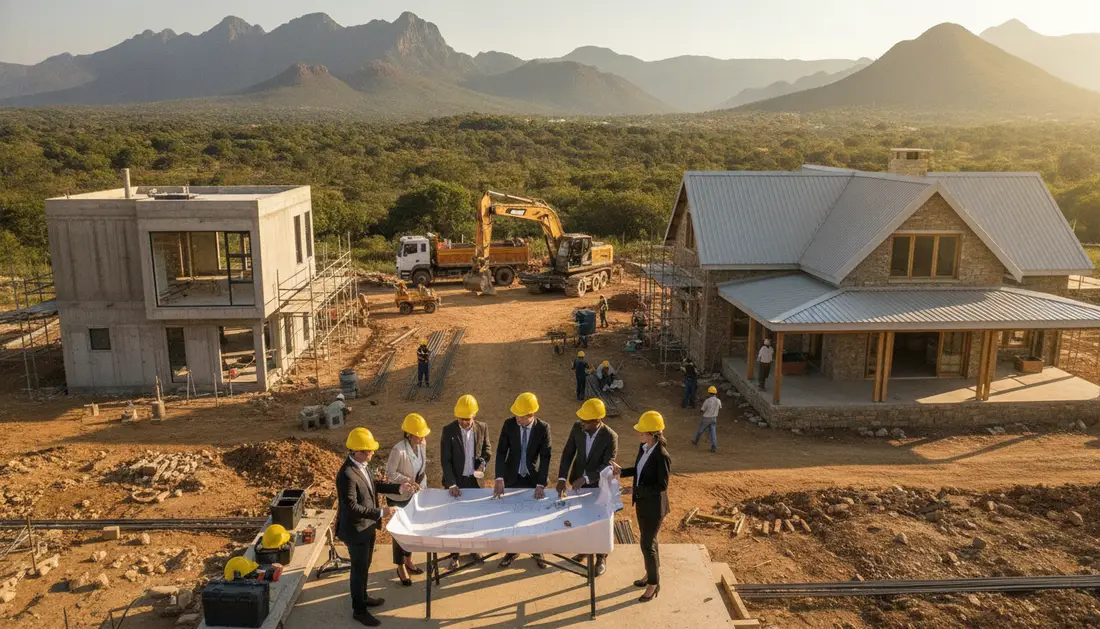
Our platform gives clear, practical guidance on pricing and common construction drivers. We explain which costs matter most: materials, labour, finishes and local approvals. This helps you plan and compare quotes with confidence.
Whether your project is a compact dwelling or a larger custom build in Cape Town, our pricing guidance highlights regional factors such as site preparation and regulatory needs. Use this short introduction as your first step towards better budgeting and smarter decisions.
Understanding the Cost to Build a House South Africa
Knowing the full price sheet for a new home helps you avoid surprises during the build. We break the figures into clear sections so you can compare quotes and set a realistic budget, starting from the cost per m² to build and scaling up to the full sheet.
Typical reality: construction budgets often run 20–30% higher than buying an existing property — a gap that reflects finishes, site work and compliance fees rather than poor planning, all of which the 10 steps to building a house walk through in order.

Average three‑bedroom homes measure between 120 and 150 square metres — a useful baseline when you convert per‑metre prices into a total, and a fair guide to how long it takes to build a house of that size.
- Look beyond headline prices: include labour, materials, professional fees and approvals.
- Many Cape Town clients accept a higher initial price for long‑term value in a custom home.
- We provide current prices and scenarios so you can see how market shifts affect your plan.
Every project differs. Use these points to check quotes and confirm which items are included before you commit — and budget separately for soft costs like how much do building plans cost, which buyers routinely forget. Our guide to how much do building plans cost in south africa covers what’s involved.
The levers you can actually pull are well documented: the cheapest way to build a house without cutting structural corners, scheduling around the risks of building in the rain, and getting ahead of what causes building cost overruns before they eat your contingency. If you have not secured a stand yet, work through the buying land to build checklist first, then compare the numbers here against the price guides hub as a whole.
Why Building Your Own Home is a Strategic Investment
A new build can deliver modern systems and fewer maintenance surprises than a resale property.
You gain immediate benefits: modern, energy‑efficient technology lowers running expenses and reduces long-term maintenance costs. A property that has never been occupied also means fewer hidden repairs and no legacy defects.
There are fiscal advantages. When you choose to build from scratch you often avoid transfer duty and some administrative fees linked to buying an existing dwelling. This improves your overall financial position during the first year.

- Customisation: design finishes and layouts that match your lifestyle.
- Efficiency: fit modern systems that cut energy and water bills.
- Value: well‑planned new property can increase in market value over time.
| Advantage | What it means | Where it helps |
|---|---|---|
| Custom specification | Choose materials and layout you prefer | Long‑term satisfaction and resale |
| Lower initial transfer fees | Save on duty and admin when compared with resale | Improves early cashflow |
| Modern efficiencies | Reduced running and maintenance costs | Strong in competitive markets like Cape Town |
| Fresh start | No inherited defects or unseen repairs | Peace of mind and fewer surprises |
We provide clear data so you can assess whether this investment fits your goals. If you plan a new home in south africa, our platform helps you compare likely costs and request targeted quotes.
Key Factors Influencing Construction Expenses
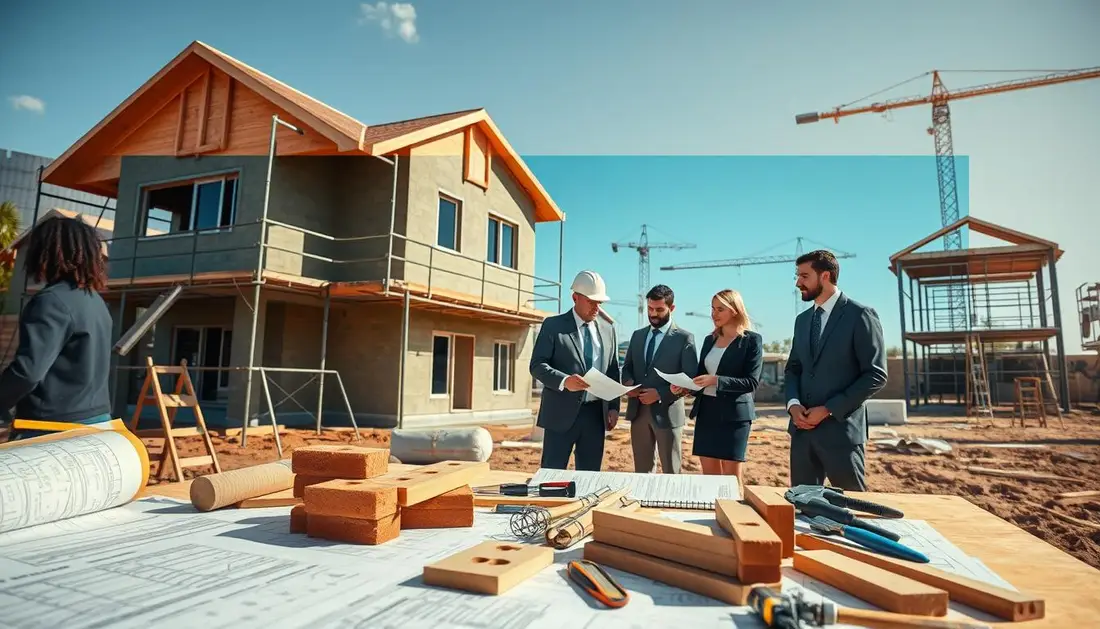
Understanding which site and design elements drive your final invoice lets you plan a realistic budget. Footprint and storeys matter most: single-storey building costs behave very differently to building up, so price your layout before you commit to a plan. It reads well alongside what single storey building costs.
Physical land condition
The nature of your land affects many line items. Poor soil, steep slopes or existing structures add time and expense for clearing, earthworks and drainage — and on a tight stand, double-storey building costs can work out cheaper per square metre than spreading out.
Hidden services or rubble increase the likelihood of unexpected construction costs. Assess access for delivery vehicles; restricted entry raises transport charges for materials.
Project complexity
Complex designs raise labour hours and material diversity. For example, a double‑storey layout usually costs more than a single level even at the same footprint. This pairs naturally with what double storey building costs.
Quality and design choices are also major factors. Higher specification finishes and intricate details push prices up quickly, while simple layouts help control the budget.
- Location: remote sites in Cape Town suburbs may attract higher transport and contractor travel fees.
- Site works: demolition, stabilisation or retaining walls should be allowed for early in your budget.
- Access: poor site access is a common cause of surprise expenses — check this before you sign.
By identifying these factors early, you can manage expectations, reduce surprises and keep your project financially viable.
Analysing the Cost per Square Metre
Breaking prices down per square metre gives the clearest forecast for your project budget.
In 2026 our baseline starts at about R9,500 per square metre for an economical home, while premium and architectural finishes push prices to R20,000–R30,000+ per square metre in many cases.
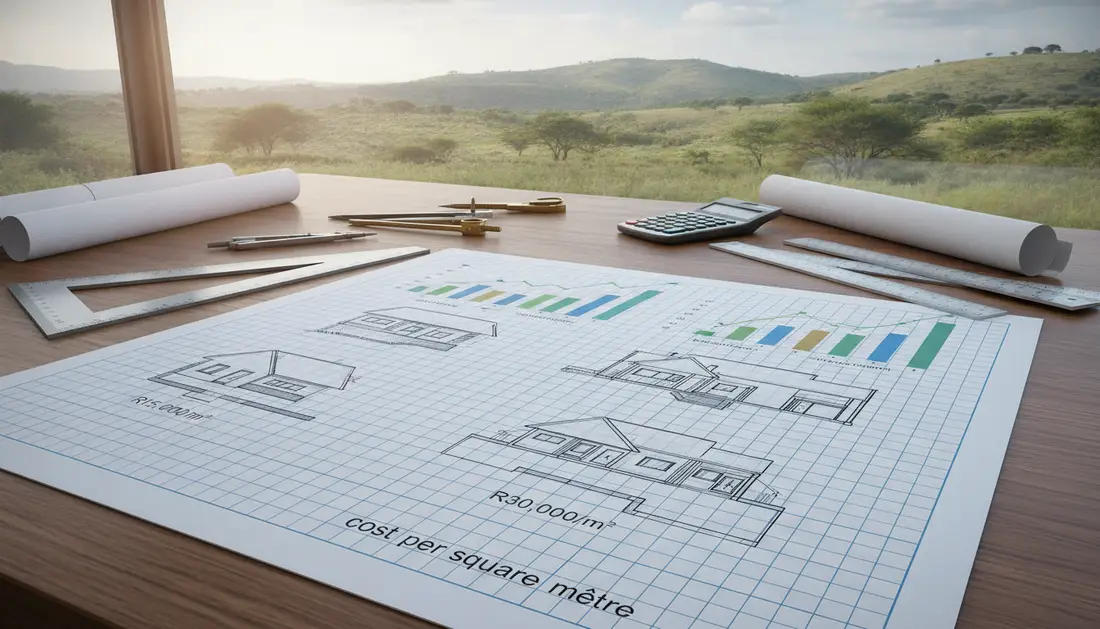
Analysing the cost per square metre helps you compare layouts, materials and design quickly. Use it as a baseline, then adjust for site factors and regional labour rates in Cape Town.
“Per‑metre figures give a practical starting point; the final amount depends on finishes and site work.”
- Size matters: larger footprints can lower the price per square metre through efficiencies.
- Quality and finishes: the choice between economical and luxury specification drives large swings in price.
- Design complexity: rooflines, split levels and bespoke joinery increase labour and materials.
| Size (m²) | Economic (R) | Mid‑range (R) | High‑end (R) |
|---|---|---|---|
| 90 | R585,000 | R1,170,000 | R1,800,000+ |
| 130 | R845,000 | R1,690,000 | R2,600,000+ |
| 180 | R1,170,000 | R2,340,000 | R3,600,000+ |
| 250 | R1,625,000 | R3,250,000 | R5,000,000+ |
Use these figures as guidance. The average cost per square metre is useful, but always confirm allowances for site preparation, approvals and specific materials in your quote request.
Regional Variations in Building Rates
Regional price differences can change your project budget as much as design choices. KwaZulu‑Natal currently shows the highest rate at R16,700 per square metre, while North West is more affordable at R9,100. These figures illustrate how location and local markets shape your planning.
Urban areas usually record higher labour and material prices than rural zones. That trend pushes building costs up in major centres and affects the average cost per square metre you should expect.
Key factors include local labour availability, distance from suppliers and site access. Each affects the cost per square and the final price you will quote by contractors.
- Compare regional rates so your budget matches your chosen location.
- Use our data to adjust for size and construction complexity.
- Consult local contractors in Cape Town for precise, location‑specific estimates.
Breakdown of Costs by Build Stage
Understanding how expenses fall across stages helps you control the budget and avoid shortfalls. We split the build into three practical phases so you can track progress and funds as your project moves from foundations through enclosure to final finishes.
Foundations and structure
Concrete foundations for a 100m property commonly start from R23,000. This stage covers excavation, strip or raft footings, and the main masonry work using bricks or block.
Labour typically makes up 25–30% of total expenses and is heavily weighted at this early phase. Structural quality here reduces later remedial spending.
Roofing and enclosure
Roofing, external doors and windows move the project towards weather-tight status. Material choice — tiles, sheeting or trusses — affects the per square metre rate and the timeline.
We advise confirming material and labour rates in writing before this stage starts to prevent surprises when sourcing building materials.
Interior finishes
Final finishes account for a large share of the visible quality: joinery, tiling, paint and fittings. This is where design and specification drive the greatest variation in prices and perceived value.
“Monitor stage percentages closely — it prevents running out of funds before your home is enclosed and ready for occupation.”
| Stage | Typical share (%) | What it covers |
|---|---|---|
| Foundations & structure | 25–35% | Excavation, concrete, bricks, loadbearing walls |
| Roofing & enclosure | 20–30% | Roofing, windows, external doors, insulation |
| Interior finishes | 35–45% | Plumbing, electrical, joinery, tiling, paint |
- A typical breakdown shows the foundations first, then roofing, then finishes.
- We help you track per square and per square metre rates for each stage so your budget stays aligned with design and quality choices.
- Always get written confirmation of material and labour rates from your contractor, especially for bricks and other key building materials.
Essential Professional Fees and Permits
Planning and professional charges ensure your design is safe, legal and bankable. They sit outside the construction figure but shape your timetable as much as your budget — the council approval costs and delays alone can add months before a brick is laid.
Architect fees typically run up to 8% of the total construction figure, and land surveyor charges can reach about 5% — though for a straightforward home the architect vs draughtsperson choice can cut that bill substantially.
Mandatory additions include NHBRC enrolment and council plan approvals. If you plan a new home in south africa, factor these into your early estimates. For the how-to, see renovation vs new build cost comparison.
- Essential professional fees, including your architect and structural engineer, are critical for projects in cape town.
- Allow for NHBRC and municipal plan approval costs; these are compulsory for any house project.
- Set aside a contingency of 10–15% to cover these fees and unexpected planning changes.
“Confirm the scope and fee structure in writing with each professional before work starts.”
Our pricing guidance helps you estimate these fees so you can allocate funds clearly and keep your project compliant and structurally sound.
Managing Stand-Related and Site Preparation Costs
Separating land development items from the main building figure gives you a clearer budget picture.
Stand-related charges such as services connections and boundary walls are excluded from the standard per‑square‑metre building rate. These items sit outside the usual quote for the house and must be planned as separate expenses.
Services Connections and Boundary Walls
Site preparation may include demolition, remediation and clearing of vegetation or old structures. These tasks affect the overall timeline and the funds you need before construction starts.
“Factor site works and utility hookups into your total budget rather than the per‑metre figure.”
- Get separate quotes for boundary walls and utility connections so your total budget is accurate.
- When preparing land in Cape Town, set aside funds for these site‑specific expenses and municipal fees.
- Always confirm which site tasks your contractor includes in writing to avoid hidden charges.
We help you compare estimates so you can distinguish what belongs to land development and what covers building materials and labour for the home.
Navigating the Building Loan and Payment Draw Process
A clear payment-draw plan keeps builders accountable and protects your budget during construction. Banks release building loan funds in stages, only after specific phases are inspected and signed off — and because lenders expect an enrolled builder, it is worth knowing how nhbrc registration can affect building costs up front.
Understand the stages before you sign any contract; lenders typically inspect foundations, roofing and finishes before each payout. How tightly you manage that process comes down to the owner-builder vs turnkey contractor route you choose.
You must provide proof of the builder’s NHBRC registration to qualify for a building loan. This is a non-negotiable document for most banks and for projects in cape town.
- Staged payouts protect your budget and ensure progress matches payments.
- We explain options such as a deposit requirement or applying for a 100% bond.
- Align draws with milestones so you control workmanship and timelines.
Discuss the schedule early with both bank and contractor and confirm inspection criteria in writing. Our platform helps you prepare site plans, building contracts and the documentation banks require for a smooth application.
“Match payments to inspected milestones and keep records of every draw.”
Comparing Traditional Brick and Alternative Building Methods
Choosing between traditional masonry and modern systems affects your budget, timeline and long‑term maintenance. We compare the main options so you can decide which aligns with design, quality and site factors.
Traditional Masonry
Brick-and-mortar walls are familiar and durable. They deliver strong thermal mass and proven longevity.
Drawbacks: masonry often requires more labour and longer on-site time, which raises the initial cost and per square metre rate.
Sustainable Alternatives
Timber frames, steel studs, bamboo or stone panels offer lower on-site labour and faster assembly. These methods can reduce carbon emissions and energy use over the life of your home.
Benefits: some alternatives are quicker and more economical per square metre, and they allow distinctive finishes and modern design options.
- Compare durability, maintenance and initial expenditure for each material.
- Factor complexity and size into your decision — bespoke designs add labour regardless of material.
- We provide per square metre comparisons and regional notes for Cape Town so you can request targeted quotes.
Strategies for Budgeting and Cost Control
Set clear financial rules before work starts so you can measure progress. Early decisions on scope and finishes shape the final price and reduce surprises.
Always set aside a contingency. We recommend 10%–15% of the total construction costs as a buffer for unforeseen expenses.
Negotiate with contractors and favour locally sourced materials where practical. This reduces transport rates and supports local suppliers in Cape Town and other locations.
Track every change. Keep written records of agreements, variations and price adjustments so you can control your total investment through the project lifecycle.
- Plan finishes and design choices early to avoid costly late-stage upgrades.
- Monitor construction costs against your initial budget weekly or at each payment draw.
- Use negotiation and local materials to manage prices without sacrificing quality.
| Action | Impact on budget | When to apply |
|---|---|---|
| Contingency (10–15%) | Protects against unexpected expenses | Set at planning stage |
| Local materials | Lower transport and procurement rates | Select during specification |
| Written agreements | Prevents disputes and hidden price rises | Before any work or payment draw |
The Importance of Written Agreements and Warranties
A clear, written agreement protects your funds and defines expectations. If you are planning in south africa, this document becomes the reference for every decision and payment.
Confirm inclusions, exclusions, timelines and payment schedules in writing. Ensure the contract lists what the contractor supplies and what you must provide.
Warranties matter. The contract should state warranty length and what it covers for your home and any installed systems.
- Require a lien waiver from the builder to protect your property against supplier or labour claims.
- Detail professional fees and any municipal approvals so there are no hidden costs.
- Spell out remedies and defect rectification timelines to preserve quality and accountability.
“Ensure payment draws match inspected milestones and that warranties are written into the agreement.”
| Item | What to verify | Why it matters |
|---|---|---|
| Scope of work | Detailed task list and exclusions | Prevents disputes over responsibilities |
| Payment schedule | Milestones, amounts and inspection criteria | Protects funds and aligns progress |
| Warranties & lien waiver | Duration, coverage and waiver signed | Secures property and fixes defects |
We help you review contract items and suggest checking terms with a professional before you sign. This step protects your investment in cape town and elsewhere.
Utilising Our Platform for Accurate Quote Requests
Start your quote request with clarity and control. Visit buildingpricessouthafrica.co.za and begin our quote request process to receive competitive estimates tailored to your project in Cape Town.
Our platform connects you with independent contractors who will handle site visits, final proposals, timelines and warranties. You can request up to three building quotes, or up to five quote options where available, so you can compare prices and services side by side.
We do not manage construction work directly. Instead, we provide the tools and independent contacts so you find the right professional for your home design and materials specification.
- Visit buildingpricessouthafrica.co.za to start our quote request process and receive competitive estimates for your construction project in Cape Town.
- Compare up to three quotes, or up to five options where available, to review price, scope and timelines.
- Confirm which materials, labour and approvals each contractor includes in writing before you agree.
- Use our platform data to understand how per square metre figures and regional variables affect final prices.
“Compare the scope of work in every quote to ensure fair pricing and the quality you expect.”
Practical tip: ask each contractor for a clear breakdown of labour, materials and finishes so you can make an informed decision. Using our quote request process helps you shortlist independent professionals who understand the South African construction market and your local needs.
Finalising Your Vision for a Custom Home
Bringing your custom home to life needs clear priorities, practical choices and steady planning.
Balance design and budget by matching your style with site limits such as land and size. Use our pricing data when you plan work and confirm allowances for materials and labour.
Decide key items early: finishes, architect scope and who manages construction. That focus keeps cost and costs predictable and reduces late changes.
Stay engaged with contractors and review quotes carefully. Clear communication protects your investment and helps the final property reflect your vision in Cape Town and across south africa.
Summary: use this guide and our tools for informed planning, then proceed with confidence.
FAQ
What is the typical price per square metre for building a new home in South Africa?
Typical ranges vary by finish and complexity. Economical, simple builds often start around R9,500 per square metre. Standard finishes commonly fall between R14,000 and R20,000 per square metre. Premium and architectural homes range from R20,000 to R30,000+ per square metre. Always get site-specific quotes that include labour, materials, and professional fees. It reads well alongside building cost per square metre.
Which factors most affect the overall building price?
Major drivers are land slope and soil conditions, design complexity, choice of finishes, local labour rates, structural requirements, and access for materials and plant. Other cost drivers include municipal approvals, services connections, boundary walls, and specialist subcontractors such as roofers or electricians. Confirm exclusions and provisional sums in every quote. Our guide to buying land to build covers what’s involved.
How much should I budget for professional fees and municipal approvals?
Allow roughly 6–12% of the total construction value for architect, engineer and principal-agent fees on typical projects. Municipal plan fees, plan submissions and inspections vary by city — budget R10,000–R50,000 for standard suburban sites; higher for complex developments. Always ask for a breakdown of statutory fees in the tender.
Are regional building rates different in Cape Town, Johannesburg and Durban?
Yes. Coastal and major metro areas often attract higher material and labour premiums. Cape Town and certain Cape metros can be pricier due to logistics and demand. Johannesburg and Pretoria show mixed rates depending on suburb. Durban and KZN rates fluctuate with material supply and season. Request local contractor quotes rather than relying on national averages.
What is included in a typical build-stage cost breakdown?
Common stages are site preparation and foundations, structural walls and roof, external finishes and glazing, internal plastering and partitions, electrical and plumbing services, kitchen and bathroom fittings, and final finishes and landscaping. Quotes should list provisional sums, exclusions and allowances for each stage so you can track spend against progress claims.
How do site conditions influence foundation and site-preparation expenses?
Rocky ground, high water table or unstable soil requires deeper or specialised foundations and drainage, which raises prices. Steep sites need retaining walls, more excavation and plant access. Poor access increases transport and labour time. Carry out a geotechnical report early to budget accurately.
What are the cost differences between brick-and-mortar and alternative methods?
Traditional masonry tends to be familiar to local contractors and can be cost-effective for standard designs. Alternatives such as insulated panels, timber frames, or concrete systems can save time and offer improved thermal performance but may need specialised trades and imported components. Compare lifecycle value, warranty terms and local availability when choosing a method.
How much should I allocate for interior finishes and fittings?
Interior finishes vary by quality band. For kitchens and bathrooms allow significant proportions of the finishing budget: standard kitchens and bathrooms might use 15–25% of the finish budget, while premium finishes can push totals much higher. Agree on product brands, warranties and lead times before signing contracts.
What site services and boundary costs should I plan for?
Services include water, sewer, electricity and telecom connections. Where services are not at the erf boundary, you may pay for long runs or pump installations. Boundary walls, gates and driveways are often quoted separately — budget according to materials and height. Check municipal requirements for service connections and wayleaves.
How does the building loan draw process work for new builds?
Lenders usually release funds in stages after inspections or certificates of completion for each build stage. You submit a builder’s invoice and the lender’s quantity surveyor or inspector confirms progress before payment. Ensure your contract matches the draw schedule and that provisional sums are clear to avoid shortfalls during construction.
What strategies help control unexpected expenses during construction?
Keep design decisions early and fixed, use contingency (normally 5–10% of the build value), obtain multiple contractor quotes, use fixed-price contracts where possible, and record variations in writing with signed approvals. Regular site meetings and clear scope documents reduce disputes and cost creep.
When should I hire an architect, and what will they add to the budget?
Engage an architect early for site analysis, efficient planning and proper municipal submission. Architects can reduce long-term costs through efficient design, accurate documentation and tender management. Fee structures vary: fixed, percentage-based or hourly — confirm deliverables before appointment.
What guarantees and warranties should I demand from contractors?
Request written workmanship guarantees, manufacturer warranties for products and a defects liability period in the contract. Verify contractor CIDB grade, public liability cover and references. Have the final payment withheld until snag lists are completed and warranties are issued. There’s more detail in what causes building cost overruns.
How can your platform help me get accurate quotes?
We let you request independent contractor quotes and compare local builders and suppliers. Provide detailed brief information — size, finishes, site photos and services status — to receive more accurate responses. You may request up to three quotes, or up to five where available; contractors handle site visits and final pricing. For the how-to, see building in the rain.
What should I check in writing before signing with a builder?
Confirm the scope of work, fixed price or pricing mechanism, payment schedule, completion timeline, included and excluded items, provision for variations, guarantees, and dispute resolution clauses. Insist on a clear programme of works and list of nominated subcontractors and suppliers. For the full set of cost guides, see all our building cost guides.
Related building cost guides
Read & compare builder quotes with confidence
Before you weigh up prices, get fluent in what a building quote actually contains — inclusions, exclusions, provisional sums and the red flags that change the real cost.
- How to Read a Builder Quote
- Provisional Sums in Building Quotes
- Prime Cost Items in Building Quotes
- Building Quote Red Flags
- How to Avoid an Underquoted Building Project
- Questions to Ask Before Hiring a Builder
- Building Snag List Before Final Payment
- How to Compare Building Quotes Properly
- South African Building Terms Glossary
- Building Cost Inflation in South Africa
- Builder's Guarantees in South Africa
- Builder Payment Schedules and Deposits
- Building Contract Essentials
- When a Building Project Goes Wrong
Ready to compare?