How Much Paint Do I Need?
Litres, coats and coverage maths – buy right the first time
Quick answer
How much paint you need – coverage per litre, coats by surface and a simple room-by-room calculation with wastage built in.
7 min read
On this page
How many litres will you actually need to finish a room without costly extras? That question stops many homeowners before they start a project.
Planning your next painting project starts with clear information. Our platform at buildingpricessouthafrica.co.za gives practical pricing guidance to help you estimate costs for interior or exterior work.
Use our paint calculator to find the number of litres required for each wall and ceiling. Consider the surface area, the number of coats and whether a primer is needed.
We aim to help you avoid waste and finish with a professional result. With basic room measurements and your chosen colour, our service shows realistic material needs and likely product totals so you can budget confidently.
Start small, measure once and trust the figures — it makes every job smoother.
Understanding Paint Coverage per Litre in South Africa
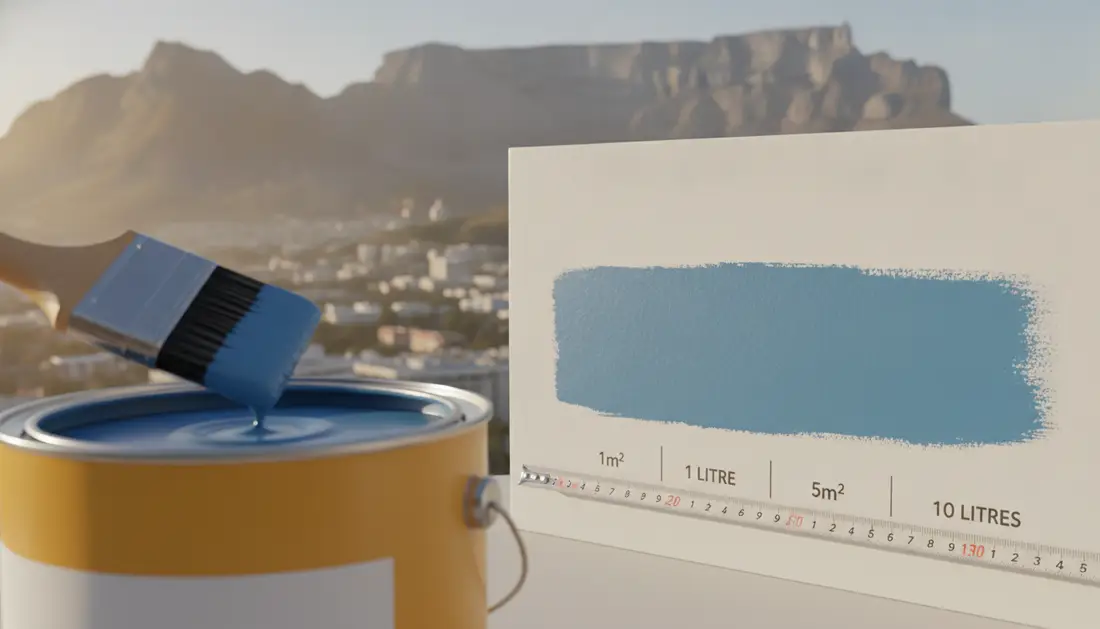
Knowing how far each litre will go is the simplest way to avoid last‑minute runs to the hardware store. A common benchmark is that one litre covers roughly 100 square feet on smooth, primed walls. In South African terms, that equals about 9–10 square metres.
Remember that rough or unprimed surfaces will reduce this figure. Porous plaster, textured finishes and bare masonry absorb more product and need extra coats. That lowers the effective coverage for each litre and raises material cost.
Always check the manufacturer’s label and product data sheet for the most accurate guidance. Different types — matte, eggshell or gloss — change how much you need. Environmental factors such as humidity and temperature also affect drying and absorption on the surface.
- Measure the area in square metres to avoid underestimating how much paint you need.
- Prepare surfaces well to maximise coverage from each litre and reduce waste.
- Use our guidance to interpret product data and plan the right number of coats for your colour and surface.
Calculating Your Project Requirements
Accurate wall dimensions are the foundation of any successful painting estimate. Use a tape measure to record height and width of each wall in metres or feet. Write down each number so you can add areas easily.

Measuring Wall Dimensions
Multiply height by width for every wall to get its area. Add the wall areas to find the total area for the room.
Example: a room with 10‑foot walls and 7‑foot height gives about 245 square feet of paintable surface after subtracting openings. Using standard rates and two coats, that equals roughly 2 litres for this example.
Accounting for Windows and Doors
Always subtract windows and doors from each wall measurement. This prevents over‑purchasing and lowers cost.
“Subtracting openings is the simplest way to avoid excess product and waste.”
- Include ceilings if you plan to finish them; this raises the total number of litres required.
- A 20‑litre bucket typically covers up to 2000 square feet, but texture and porosity change results.
- If you use a primer, run the same calculation to estimate primer litres before top colour coats.
Use our paint calculator to enter your measurements and get a clear estimate for your interior project. That gives the number of coats and litres you will need for each wall and area.
Factors Influencing Surface Absorption and Coat Counts
How your walls absorb product determines the number of coats required.
Surface texture and porosity change how much product a wall will need. Rough or unprimed walls soak up more and reduce effective yield. For example, textured walls may lower yield to about 70–80 square feet from a smooth standard.
Surface Texture and Porosity
New plaster and bare masonry are porous and will demand extra product to reach an even finish. Proper sealing and preparation cuts waste and often lowers how many coats you must use.
Impact of Colour Changes
Going from a dark colour to a lighter shade usually raises the number of coats needed. Applying a good primer first can reduce that number and improve final tone.
Environmental Conditions
High humidity or cold weather slows drying and may force longer intervals between coats. That affects project time and can change how efficiently you use product.
| Factor | Effect on Coats | Practical Tip |
|---|---|---|
| Textured walls | Increase coats; lower yield | Use thicker nap rollers and budget extra litres |
| Porous surfaces | Absorb more product | Prime or seal before top coats |
| Colour change (dark→light) | More coats likely | Apply quality primer to reduce coats |
| Humidity / cold | Slower drying; longer project | Plan drying time and avoid back-to-back coats |
Finalising Your Painting Project with Professional Guidance
Confirming scope and access saves time and unwanted extras. Check site factors, finishes and materials so quotes reflect the true job.
Our platform at buildingpricessouthafrica.co.za connects you with independent contractors who will assess walls, surface preparation and region-specific costs.
Use our pricing guidance and the paint calculator to form an initial estimate for the number coats and colour choices. It reads well alongside why paint peels and flakes.
Always ask contractors to confirm labour, inclusions, timelines and warranties in writing. That protects your home and budget.
Request multiple quotes, compare written details, then approve the one that best matches site realities and value for your room or entire project.
Get the detail from painting costs.
FAQ
What is the easiest way to estimate how much paint I need for a room?
Measure the length and height of each wall, subtract areas for windows and doors, then multiply to get the total square metres. Divide that area by the typical yield of your chosen product to estimate the amount needed for one coat, then multiply by the number of coats. Always add 10% for waste and touch-ups.
How do I account for windows and doors when measuring walls?
Measure each window and door and subtract their combined area from the wall total. For a quick rule of thumb, deduct 2–4 m² per average-sized door and 1–2 m² per window if you don’t have exact sizes. Confirm final figures on-site before buying materials.
How many coats will I need for interior walls and ceilings?
Most interior walls need two coats after a primer—one for sealing and one for finish. Ceilings often need two coats too, especially if they’re bare plaster or previously dark. If you’re changing from a dark colour to a light one, plan for three coats or a tinted primer.
How does surface texture affect how much product I use?
Rough or highly porous surfaces absorb more product and reduce yield per unit, so you’ll need more material and possibly a primer or sealer. Smooth, well-prepared plasterboard or existing sealed surfaces typically need less. Check the technical data sheet of your chosen brand for guidance.
Will changing to a dramatically different colour affect coverage?
Yes. Moving from dark to light (or vice versa) usually increases the number of coats required. Use a high-opacity undercoat or a colour-matching primer to reduce additional coats and overall cost.
How should I adjust estimates for exterior projects and environmental factors?
Exterior surfaces are exposed to sun, wind and moisture, which affects absorption and wear. Rough masonry or old render often needs a primer and extra coats. For coastal regions expect higher maintenance. Budget for more material and a higher-grade exterior product. This pairs naturally with choosing exterior paint for sa conditions.
Do I need a primer, and how does that change quantities?
Priming improves adhesion and reduces the number of finishing coats on porous or new surfaces. Include primer quantity in your calculations: treat it as one coat with its own yield and add it to the project total.
How do I calculate quantities for doors, skirtings and windowsills?
Measure linear metres and average height for skirtings and window frames, then convert to square metres. Doors and windows are measured individually. Use product data for coverage on trim, as yields differ from wall and ceiling formulations. For what this typically costs, see painting per square metre costs.
What information should I have ready before requesting contractor quotes?
Provide room dimensions, wall heights, surface type (plaster, gypsum, masonry), number of windows and doors, current condition (new, previously painted, flaking), desired finish and colour changes. Ask contractors to confirm coat counts, materials, labour rates and warranty in writing.
Can I rely on online calculators for a precise material list?
Online calculators are useful for quick estimates but use average yields and assumptions. Treat their output as a starting point. For accuracy, verify on-site measurements and discuss surface condition with a contractor who can adjust quantities for absorption, texture and access issues.
Ready to compare?