
Prime Cost Items in Building Quotes
Fixtures, fittings, finishes, and allowances that can move the real budget after approval
Quick answer
Prime cost items in building quotes – how allowances for tiles, sanitaryware and fittings move your final price, with worked examples.
10 min read
On this page
Do you know how allowances in your contract can change the final price?
Navigating these figures needn’t be confusing. At buildingpricessouthafrica.co.za we help you see how allowances work so you can protect your budget.
Our platform explains why a clear building contract should list estimates for every prime cost and provisional sum entry, so you can see exactly what has been allowed for and what has not.
We show the difference between a prime cost item and a provisional sum, and how each allowance affects the total amount you will pay.

Use our pricing guidance to compare several offers, confirm excavation and site needs, and ensure fixtures, fittings and appliances are covered in the estimate.
Clear documentation and realistic allowances keep surprises at bay and help you manage time, works and the final price with confidence.
Understanding Prime Cost Items Building Quotes in South Africa
Understanding how allowances are shown in your contract helps prevent unexpected increases when work starts.
Prime cost entries cover materials such as tiles or taps that you have not picked when you sign your contract. These entries give a provisional monetary figure for each cost item so the builder can include allowances in the tender.
Provisional sums are different. They apply to work not yet defined — for example, excavation or soil testing where the final amount is unknown. A provisional sum is an estimate for that work until scope and site factors are clear.
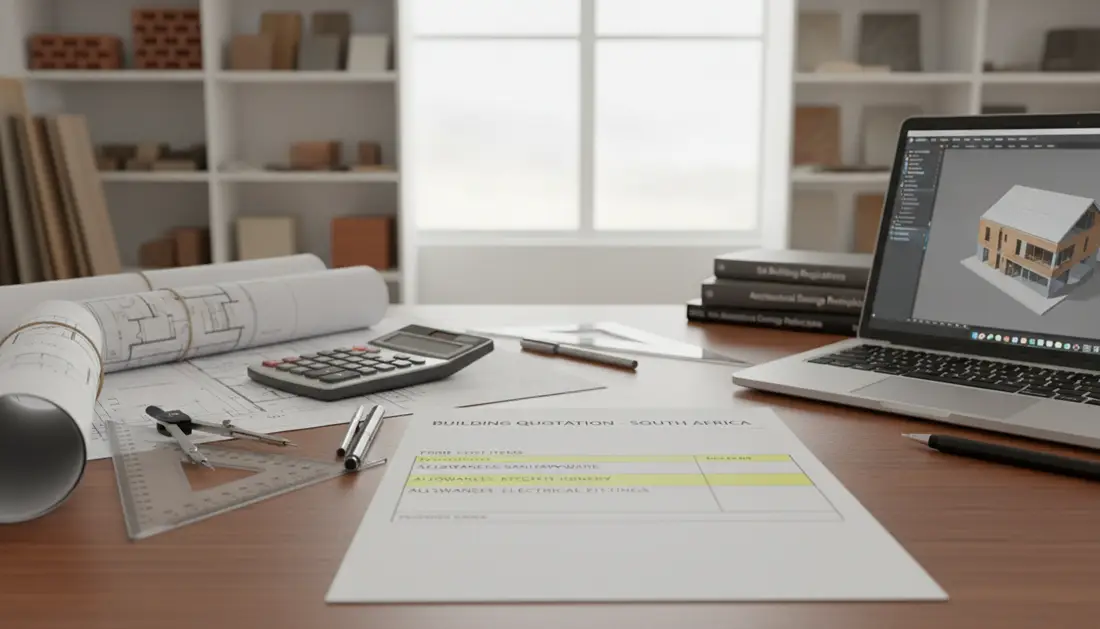
In South Africa, our pricing guidance helps you distinguish between prime cost entries and provisional sums so your budget stays intact. We advise you to request multiple quotes and to verify every allowance and sum with your builder. This pairs naturally with why calculator numbers differ from real quotes.
Transparent contracts and early clarification of allowances reduce the chance that your final home price exceeds the agreed amount. Verify that all cost items and sums reflect current market rates before signing.
Defining Prime Cost Versus Provisional Sums
Clear definitions help you spot where estimates end and actual charges begin.
Prime cost items refer to the supply of specified materials that have not been finalised when you sign the contract. They show an allowance for goods like fittings or fixtures and require a written breakdown from your builder, with estimated quantities and unit prices.
Provisional sums cover work that is not yet defined — typically labour‑heavy tasks such as excavation or soil testing. A builder should use reasonable care and skill when calculating any provisional sum, so these entries must reflect realistic site conditions.
- According to the Act, a supplier or builder must estimate each cost item with care based on the specific site.
- Distinguish materials from labour: supplies are shown as allowances; undefined works appear as provisional sums.
- Check that the contract lists quantities and unit prices for every cost item and allowance.
- When you see a provisional sum, confirm site preparation such as soil and excavation is included.

Why this matters: the difference between a prime cost item and a provisional sum can change the final amount you pay. Ask your builder for transparent entries so you can manage time, price and the construction process with confidence.
Managing Your Budget Through Accurate Selection Allowances
Selecting realistic allowances for finishes and fittings helps you control the final sum on your contract.
How Tile Allowances Impact Final Costs
Example: a R150/m² tile allowance in your contract leaves a shortfall if you pick R320/m² tiles.
If you choose the pricier tiles, you must pay the difference for materials and any related labour. That extra amount is added to the contract final price.

Sample Schedule of Prime Cost Allowances
| Item | Allowance | Quantity | Notes |
|---|---|---|---|
| Sanitaryware | R2 500 each | 4 | Standard basin & WC |
| Tiles | R150/m² | 50 m² | Floor tiles allowance |
| Light fittings | R350 each | 10 | Standard fittings |
| Ironmongery | R800 set | 8 | Door handles & locks |
Strategies for Minimising Budget Fluctuations
- Using our pricing guidance, create a schedule of allowances for sanitaryware, tiles, ironmongery and light fittings.
- Ask the builder for clear estimates for each provisional sum, such as excavation or soil testing.
- Compare quotes through our platform to find builders who give realistic allowances for your home.
- Monitor allowances closely — exceeding them will increase the final amount on your contract.
“A well-structured contract lists each selection allowance and provisional sum so there are no surprises.”
Essential Documentation and Contractual Protections
A written schedule of each allowance and provisional sum gives you legal footing if a cost rises.
Good practice — and a clear written contract — requires that all prime cost items and provisional sums be set out in writing.
Before you sign any contract, use our confirm-allowance list to check that every prime cost item and provisional sum is listed with quantities and unit amounts.
Verifying Inclusions and Warranties in Writing
Make the builder add a separate schedule for each cost item and sum. Ask for specific warranties covering workmanship and materials.
- Request receipts or invoices for any prime cost provisional or cost provisional sum as soon as the expense is incurred.
- Confirm how any excess amount for a prime cost item or provisional sum will be calculated and charged.
- Never accept verbal promises about allowances; get them in the contract.
“Documentation is your primary protection; written proof prevents disputes over the final amount.”

Our platform recommends you request evidence of actual costs for any cost items so you only pay the difference. Clear records protect your site, your finances and the final construction outcome.
Final Steps for Securing Your Building Budget
A final review of all sums helps you avoid unexpected increases to the contract amount.
Benchmark every allowance against real selections for your home, such as appliances and fixtures. This shows the likely difference between your choice and the builder’s allowance.
Remember a provisional sum is an estimate. Keep a contingency fund for any unforeseen work or site conditions during the construction process. For what this typically costs, see how we estimate building costs.
Use our quote request process at buildingpricessouthafrica.co.za to connect with independent contractors who supply transparent building contracts and clear cost items.
Always review the final quote so the amount added for any difference is clearly explained and agreed. Follow these steps to keep your project on time and on price.
FAQ
What are allowances in building quotes and how do they work?
Allowances are provisional sums listed in your contract to cover fittings or finishes not yet selected. They give a contractor an estimate for budget purposes. When you choose actual items — for example, kitchen appliances or bathroom fittings — the final invoice is adjusted up or down from the allowance to reflect the real supplier price and installation costs. Always confirm who pays for delivery, damage, and supplier warranties in writing.
How do provisional sums differ from selection allowances?
A provisional sum is an allowance for work or supply where scope or quantities are uncertain, such as excavation through unknown soil. A selection allowance applies specifically to finish items like taps, basins, or light fittings where you still need to pick style and brand. Provisional sums often include labour; selection allowances usually cover the supply of materials only, with installation charged separately unless noted.
What should I check in the contract about allowances and provisional sums?
Check the breakdown showing whether an allowance includes supply, installation, VAT, or delivery. Confirm who chooses the supplier, acceptable brands, and the process for credit or additional charges. Specify timing for selections and the period for price confirmations. Require written records for any variation and clear methods for calculating differences so you avoid surprises.
How do allowances affect the final price and my budget?
Allowances are starting figures. If you pick items that cost more than the allowance, you pay the difference; if cheaper, you receive a credit. Labour and accessories may push the final figure higher, so budget a contingency of 5–15% above all allowances. Review sample schedules of allowances to compare with market prices for fittings and appliances in your area.
Can I replace an allowance item after work has started?
Yes, but changes after commencement will usually be treated as variations. That can affect time and cost because the contractor may need to reorder, rebook trades or alter installations. Agree a cut-off for selections in the contract and communicate changes promptly to limit extra charges. It reads well alongside what builders need before they can quote you.
Who is responsible for selecting finishes and paying for upgrades?
The client chooses finishes unless the contract specifies otherwise. Upgrades beyond the contract allowance are your cost. Some builders offer supply-and-fit packages with fixed prices for certain brands; ask for a written upgrade schedule that lists the extra cost for popular choices like ceramic tiles, Caesarstone countertops or freestanding baths.
How should I set realistic allowances for tiles, taps and cabinets?
Get current retail or trade prices for the exact products you like, then add margins for delivery, waste (usually 5–10% for tiles), and installation. For tiles, include substrate preparation and waterproofing. Use local building-material suppliers for price checks and ask contractors to base allowances on named products to reduce variance.
What happens if the actual supplier invoice is lower than the allowance?
The contract should state you receive a credit for the difference. Confirm whether the credit is passed back in full or after any agreed contractor discount. All supplier invoices and receipts should be supplied as evidence for the final account.
Are warranties and guarantees affected by allowances and provisional sums?
No — warranties from manufacturers and contractor workmanship guarantees remain valid if items are installed correctly. Ensure the contract lists warranty terms and that suppliers used meet those requirements. Ask for manufacturers’ warranty documents and an installer’s certificate where applicable.
How do regional factors in South Africa influence allowance pricing?
Labour rates, transport costs and supplier availability vary by region. Remote sites or difficult access increase delivery and site-prep allowances. Always request allowances that reflect your town or suburb, and confirm whether the contractor includes travel, overnight stays for specialist trades, or local council approval fees.
What documentation should I keep to manage allowance adjustments?
Keep the signed contract, schedule of allowances, invoices from suppliers, delivery notes, variation orders and written approvals for any changes. These documents protect you when reconciling the final account and when claiming warranties or disputing charges.
How can I minimise surprises from provisional sums and allowances?
Choose finishes before signing where possible, or specify a short selection window in the contract. Use named products and suppliers with firm prices. Ask for itemised allowances that separate supply, installation and VAT. Budget a contingency and request up to three independent contractor estimates to compare allowances and workmanship assumptions.
Should allowances include demolition, disposal and site preparation?
They should, if those works are required. Demolition, rubble removal, hazardous-material handling and site stabilisation are often separate provisional sums. Confirm whether the allowance covers disposal fees, skips, and reinstatement so these costs are not left off the final account.
When is a provisional sum used for unknown ground conditions?
Contractors use provisional sums when sub-surface conditions may change the scope — for example, unexpected rock or contaminated soil requiring extra excavation or engineering. Insist on geotechnical reports where possible and include clear guidance in the contract on how additional excavation costs are measured and approved. This pairs naturally with building contract essentials.
Ready to compare?