
Ceiling Insulation Options and Rules
Thickness, types and the energy rules – comfort you install once
Quick answer
Ceiling insulation options in South Africa – types, thickness and the SANS energy rules – plus when re-roofing is the cheap moment.
14 min read
On this page
Can one smart upgrade cut your power bill and make your home noticeably more comfortable?
Choosing the right solution matters. Our platform, buildingpricessouthafrica.co.za, offers clear pricing guidance so you can weigh your options without guesswork.
We explain common materials and ceiling types in plain terms and show cost ranges you can expect. You will learn what affects price: labour, material quality, roof access and approvals.
Use our pricing guidance to compare quotes and pick installers with confidence. Our streamlined quote request links you to independent contractors across the country so you can get realistic costs fast.

Start here to understand scope and likely costs before you agree to work. That way you avoid surprises and make a sensible investment in your home.
Why Ceiling Insulation Matters for South African Homes
Small upgrades above your living spaces can yield big savings and more steady indoor temperatures.
Up to 35–40% of household energy can be lost through an unprotected roof space. Installing high-quality insulation stabilises temperatures and cuts that loss.
Proper thermal control reduces the load on heating and cooling systems. That lowers bills and improves comfort year-round. Our pricing guidance shows how material choice and installation quality affect long-term efficiency.

Thermal regulation and energy savings
Stabilises indoor heat and cold. In summer, reflective and bulk layers limit radiant heat entering living areas. In winter, they keep heater-warmth inside.
This reduces HVAC runtime and preserves building fabric from extreme temperature swings.
Acoustic benefits and noise reduction
Dense material also absorbs sound. That cuts rain, road and neighbourhood noise for a quieter home.
Quieter rooms improve sleep and make homes more liveable without extra energy use.
| Aspect | Typical benefit | Seasonal effect | Estimated saving |
|---|---|---|---|
| Thermal performance | Stable indoor temperatures | Less summer gain / less winter loss | 10–30% on heating & cooling |
| Acoustic performance | Reduced external noise | Year-round quiet | Improved comfort |
| House fabric protection | Lower thermal stress | Reduces material movement | Long-term maintenance savings |
Understanding SANS Energy Requirements
SANS 10400-XA is the national standard that sets energy performance targets for new homes. It requires measurable thermal resistance so a building controls heat flow effectively.
In plain terms: the rules specify minimum R-values for your roof insulation and the layers above living spaces. Meeting these values helps your home use less energy for heating and cooling.
Complying also protects resale value. Buyers and valuers look for certified energy features. A compliant building often commands a higher asking price and faster sale.
- The standard mandates R-values for the roof and ceiling areas to ensure long-term energy savings.
- Our platform explains how these legal limits affect material choice and installation scope.
- Confirm compliance with your contractor and get it written into the quote to avoid future approval issues.

| Requirement | What it means | Action for you |
|---|---|---|
| SANS 10400-XA | Minimum thermal resistance (R-value) for roofs and living spaces | Request R-value compliance details in quotes |
| Compliance proof | Documentation by installer or product certification | Ask for certificates and include in contract |
| Effect on value | Better energy performance increases market appeal | Keep records for future sale and valuations |
Comparing Ceiling Insulation South Africa Price Ranges
Start with a clear price-band comparison so you can budget your project and spot outlier quotes quickly.
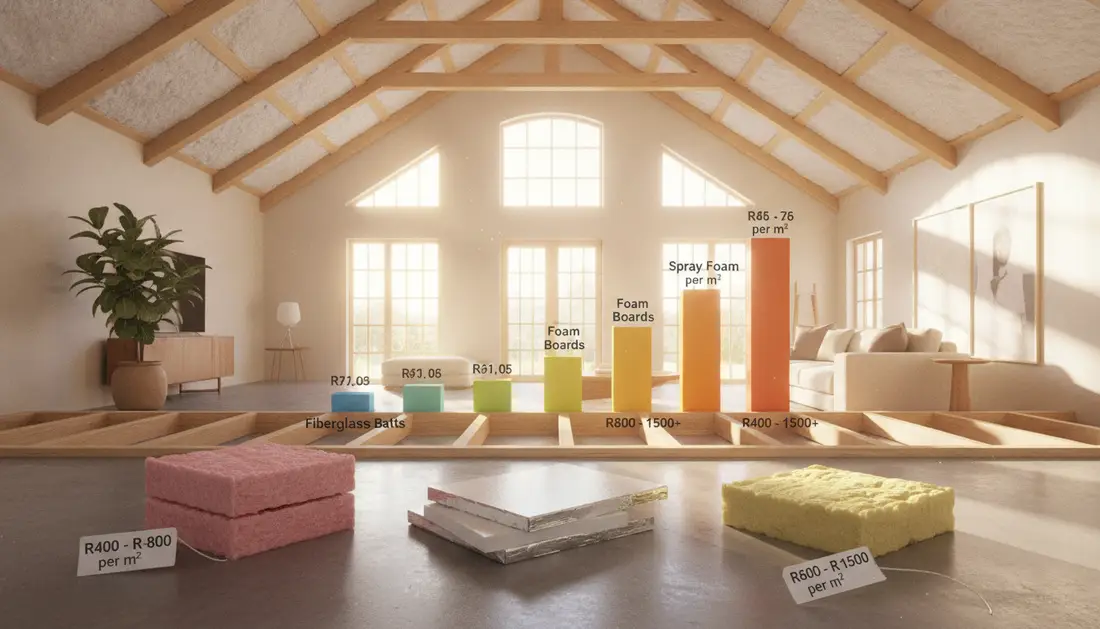
Our pricing guidance summarises current price ranges for common roof insulation products and fits typical project scopes.
- Our pricing guidance provides a clear overview of the current price range for various products available in the market.
- When comparing insulation prices south of the country or elsewhere, remember costs change with site access and labour needs.
- Confirm inclusions, exclusions, timelines, payments and warranties in writing before you start work.
- The total price for your ceiling work depends on materials chosen — glasswool or polyester — and installation complexity.
Use quotes to compare value. Request multiple offers via our quote process to check you are getting a fair price range and that removal of old material is included.
Bulk Insulation Materials for Thermal Performance
Choosing the right bulk product controls heat flow, fire safety and long-term performance.

Glasswool options for fire safety
Glasswool products deliver high thermal resistance and excellent fire protection.
Knauf Earthwool 135mm: R-value 3.38, density 12kg/m³. Aerolite 135mm: R-value 3.38, density 11kg/m³.
- Both are non-combustible with strong resistance to heat and suited to residential and metal roof structures.
- They usually cost more up-front but offer superior long-term performance and peace of mind regarding fire.
Polyester alternatives for sensitive handling
Polyester options suit DIY and installers needing low-itch handling.
Fabufill 100mm: R-value 2.20, density 10.1kg/m³.
- Polyester is softer, easier to fit and often cheaper by price per roll.
- Consider the lower R-value when comparing overall thermal performance.
Thermal boards for rigid applications
Thermal boards give a neat finish and stable resistance where a rigid product is needed.
Use our pricing guidance to compare the price range of glasswool, polyester and boards before you decide.
| Product | R-value | Density (kg/m³) |
|---|---|---|
| Knauf Earthwool 135mm | 3.38 | 12 |
| Aerolite 135mm | 3.38 | 11 |
| Fabufill 100mm (polyester) | 2.20 | 10.1 |
Reflective Foil Options for Radiant Heat Control
A reflective foil layer can be an affordable way to lower indoor temperatures where solar exposure is highest. These products block radiant heat before it enters the roof cavity and improve overall thermal performance.
Use foil with bulk layers — combining a reflective barrier with a bulk material creates a complete insulation roof system that performs well in hot climates.
- Foil works with metal or tiled roofs to reduce daytime heat gain and lower peak indoor temperatures.
- Product performance varies by surface finish, thickness and installation gaps; choose a certified product for consistent results.
- Price range depends on foil grade and the number of layers — discuss options and costs with a contractor before you buy.
Practical tip: request product specifications and a simple price comparison in your quote so you know the expected lifespan and thermal benefit.
Insulation Thickness and Material Density Guidance
Thickness and material density together determine how well your roof performs across seasons.
Selecting the correct thickness and density is vital to reach the resistance and efficiency you expect.
Insulation Types Table
Below is a clear comparison of common glasswool and polyester products. Use it to compare R-values, density and likely performance.
| Product | Thickness (mm) | R-value (approx.) | Density (kg/m³) |
|---|---|---|---|
| Knauf Earthwool (glasswool) | 100 | 2.50 | 12 |
| Knauf Earthwool (glasswool) | 135 | 3.38 | 12 |
| Fabufill (polyester) | 100 | 2.20 | 10.1 |
| Fabufill (polyester) | 150 | 3.30 | 10.1 |
- A higher density usually improves acoustic performance; greater thickness raises thermal resistance.
- The price range for your project will rise with thicker products, but so will long-term savings from efficiency.
- Always check the manufacturer’s recommended thickness and fire data before you buy or install.
- We recommend you consult an independent contractor to confirm the optimal thickness for your roof type and local climate.
Retrofit Versus New Build Installation Economics
Choosing when to add roof insulation affects price, access and long‑term value.
During a new build, installers work with an open roof structure. Labour is faster, waste is lower and the chosen product fits cleanly into the design. That reduces the per‑m² installation cost and improves thermal performance from day one.
Retrofit work suits existing homes. It often costs more in labour because access is limited and installers must protect finishes. Despite higher upfront labour, retrofits deliver clear energy savings through winter and summer and raise comfort quickly.
- New build: lower price per unit, simpler compliance with standards, easier to specify polyester or higher‑density products.
- Retrofit: slightly higher labour, same long‑term savings, good option when you want immediate comfort gains.
Our pricing guidance shows the economics: the earlier you invest in quality materials and correct installation, the sooner your monthly bills fall and the greater the resale value of your home.
| Scenario | Typical cost effect | Key advantage |
|---|---|---|
| New build | Lower | Best value and compliance |
| Retrofit | Higher labour | Immediate comfort, energy savings |
Common Installation Errors That Halve Performance
Small mistakes at install time can cut a product’s rated performance by half. That loss shows up as higher bills and uneven temperatures across rooms.
Gaps and material compression
Leaving gaps around pipes, ducts or in corners lets heat escape through the roof space. Even a narrow void breaks the thermal barrier and reduces the effective R-value.
Compressing bulk products reduces the air pockets that provide thermal resistance. Always install at the manufacturer’s recommended thickness to get the quoted performance.
Clearance around downlights and transformers
Downlights and transformers need proper clearance to avoid overheating and potential fire risk. Your contractor must follow safety clearances and use fire-rated housings where required.
- Hire competent, independent contractors who know how to handle glasswool and foil products without damaging them.
- Verify that all joins in reflective foil are taped and sealed to maintain continuous radiant barriers.
- Ask for photos or a short completion report showing full thickness, sealed joins and clearances; include this in your quote.
Price and long‑term performance
Paid correctly, good installation preserves the value of the product you bought. Cutting corners during fitment wastes both the materials and your money.
How to Calculate Your Material Requirements
Start with a simple area measure and you’ll remove most guesswork when ordering materials.
Measure the total ceiling area of each room in square metres. Add up all rooms and service areas to get your base figure.
Allow 10% extra for overlaps and offcuts. This avoids mid‑job shortages and keeps your installation on schedule.
If you have a pitched roof, multiply the base area by 1.15 to allow for slope and extra surface area.
- Check the coverage stated on your chosen product and divide your adjusted area by that coverage to find the number of rolls or boards.
- Compare polyester options with glasswool products for cost, thickness and performance before you buy.
- Double‑check measurements for all areas and corners; small errors add up quickly to extra price.
If measuring feels daunting, request quotes through our platform so independent contractors can verify areas and give a firm price range. Accurate calculations save material, time and help secure the comfort and energy savings you expect.
Professional Assessment and Quote Request Process
A short site visit gives contractors the detail they need to price work accurately and avoid hidden costs.
Our quote request process connects you with independent contractors who will assess your roof structure and the specific product you want for the project.
When you request quotes, include clear details: roof type, access, desired performance and any preferred product. Contractors use this to scope labour and site preparation.
- Contractors inspect access, ductwork and safety needs to set a realistic price for ceiling insulation installation.
- We recommend you request up to three quotes to compare pricing, workmanship and written inclusions.
- Confirm the installer has experience with your chosen material and ask for proof of previous work and warranties.
Price factors to check include access, finishes, approvals and complexity of installation. These determine the final quote and expected energy performance of your building.
| Step | Why it matters | What to ask |
|---|---|---|
| Site assessment | Accurate scope and price | Photos and measurement confirmation |
| Compare quotes | Spot outliers and value | Request up to 3 offers via our quote request process |
| Contractor checks | Material experience & warranties | Proof of past projects and installation guarantees |
Securing Long Term Comfort and Energy Efficiency
Secure steady indoor temperatures and lower running costs by choosing the right products and professional installers.
Investing in quality insulation products is a long-term commitment to your home’s comfort in winter and summer. It reduces heat loss, improves performance and lifts value across living areas.
Visit buildingpricessouthafrica.co.za to compare prices, product options and installer quotes. Our platform helps you check pricing, resistance data and fire-safe details before you commit.
Start with clear prices, get up to three on-site quotes and confirm scope in writing. With the right product and fitment you secure quieter rooms, better efficiency and lower heating and cooling bills for years.
The full costing lives in ceiling install guide and roof replacement guide.
FAQ
What are the main ceiling insulation options and which suit my roof type?
You can choose bulk batts (glasswool or polyester), rigid thermal boards, or reflective foil systems. Glasswool batts suit timber or metal trusses and give good thermal and acoustic performance. Polyester is easier to handle, non‑itch and better for DIY. Rigid boards work well where space is tight or for flat roofs. Reflective foil is best as a radiant barrier under metal roofs in hot regions. Match the product to your roof structure, space, and fire or acoustic needs.
How does proper insulation help with energy bills in South African homes?
Effective insulation reduces heat gain in summer and heat loss in winter, so your heating and cooling systems run less. That improves comfort and cuts electricity use. A correctly installed system typically lowers HVAC running hours and shows measurable savings on monthly accounts, especially in regions with large temperature swings.
What acoustic benefits can I expect from insulating my roof space?
Bulk materials such as glasswool and thicker polyester batts reduce airborne noise and dampen impact sounds from rain or roof traffic. Rigid boards give some sound control too, but for best results combine bulk material with a ceiling lining that has acoustic properties. It reads well alongside ceiling board types compared.
What SANS energy requirements should I know when choosing products?
Look for materials that help your building meet the South African National Standards (SANS) for thermal performance, including target R‑values for your climate zone. Check product datasheets for thermal resistance and ensure the overall roof assembly meets SANS 10400‑XA energy efficiency rules where applicable.
What price ranges should I expect for ceiling insulation in South Africa?
Prices vary by material, thickness and installation complexity. Polyester batts tend to be lower cost per m² and cheaper to install. Glasswool and branded high‑density options cost more but give higher thermal and acoustic performance. Reflective foil systems are low material cost but need correct air gaps. Always confirm quoted labour, access work and any extra materials in writing before committing.
How do glasswool, polyester and thermal boards compare for thermal performance?
Glasswool offers strong thermal resistance per thickness and good fire behaviour when specified for buildings. Polyester is less dense but easy to fit and non‑irritant. Thermal boards give rigid support and consistent R‑values where batts can be compressed. Choose by required R‑value, fire rating, and installation constraints.
Are reflective foil options effective under metal roofs for radiant heat control?
Yes. Reflective foil acts as a radiant barrier and cuts down on heat transfer from a hot metal roof into the roof space. For best effect, install with a ventilated air gap; otherwise performance drops. In many coastal and inland hot areas foil plus bulk insulation gives the best combined result.
How thick should insulation be and does density matter?
Target the R‑value required for your climate zone. Thicker batts generally increase R‑value, while higher density boosts thermal and acoustic performance. Avoid compressing material, as that lowers R‑value. Consult supplier tables for R‑value per thickness and choose the thickness that fits your roof cavity without squeezing.
What common installation errors halve the product performance?
The usual problems are gaps between batts, compression under battens or storage, incorrect junction sealing, and poor clearance around fittings. Any gap, crush or missing section creates thermal bridges and cuts overall performance dramatically.
How should I treat downlights, transformers and other heat sources in the roof space?
Maintain manufacturer‑specified clearances from downlights and electrical fittings to avoid fire risk. Use fire‑rated housings where required and install fire stops around penetrations. Never cover non‑IC rated fittings with bulk material.
How do I calculate material requirements for my roof area?
Measure the plan area of the roof and subtract spaces you will not insulate. Allow a small waste percentage for cutting and overlaps. Use the product coverage figures (m² per pack) on datasheets. For accurate quantities, list lengths, widths and any obstructions then confirm with your supplier.
When is retrofit insulation more economical than fitting during a new build?
New builds allow correct sequencing and fewer access costs, so they are generally cheaper per m². Retrofits can still be economical if access is easy and the existing ceiling is intact. Retrofit costs rise where you need scaffolding, removal of existing linings, or work around services. This pairs naturally with bulkheads and cornices explained.
What should I expect from a professional assessment and quote?
A contractor should inspect roof structure, ventilation, electrical fittings and access. Quotes must itemise materials, labour, R‑values, product brands, installation method, waste removal and any additional works like scaffolding. We advise requesting up to 3 independent quotes to compare scope and pricing. For what this typically costs, see ceiling installation costs.
How do I secure long‑term comfort and energy efficiency after installation?
Ensure installers use correct products and leave ventilation paths clear. Keep service clearances and check seals around hatches and ducts. Maintain roof integrity and repair any leaks promptly. Ask for product warranties and confirm who handles post‑installation queries in writing.
Ready to compare?